Puzzles ·
A bigger board, and the taken pieces get a pile of their own
On a laptop, puzzles now open with one title row, settings and sound a click away, and the board as big as your screen allows. The pieces you take land in a little pile beside your moves, and you choose where they go.
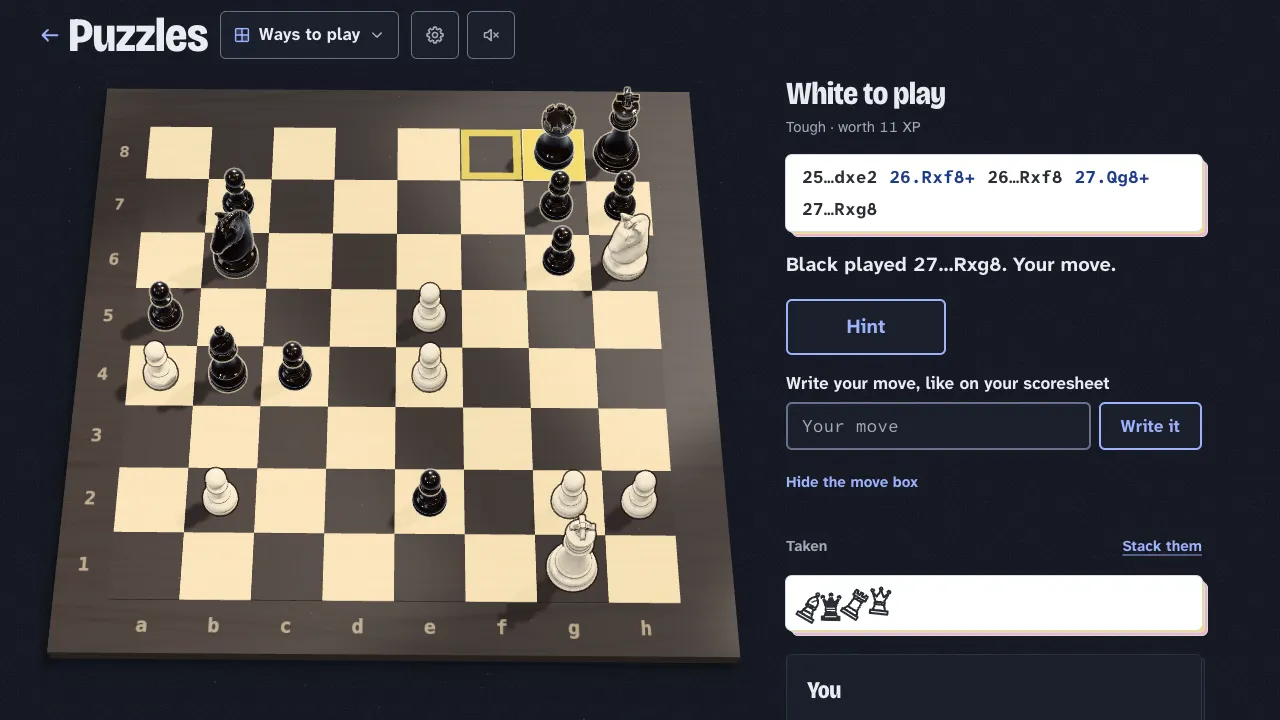
The short version
- One title row on a laptop: Puzzles, the menu, a ⚙ for settings and a speaker for sound
- “White to play” up beside the top of the board, not a scroll away
- Taken pieces land in a pile beside your moves, and “Stack them” lines them up
- The board as big as your screen allows, with nothing lying round it
- Your choice in Settings: in the side panel, beside the board, or above and below it
On a laptop the puzzle page had a habit of introducing itself twice: a small “Puzzles”, then a big heading, then the board. Now it’s one row. Puzzles, the menu for where you are (Today ▾, Practice ▾ and so on), a ⚙ that opens the board and puzzle settings, and a speaker that turns the sound on and off without opening anything. The side panel starts level with the board, so “White to play” is where your eyes already are.
Somewhere to put them
The pieces you take used to lie on the table round the 3D board, which was charming right up until there were a dozen of them and the board had shrunk to make room. Now, on a laptop, they land in a little pile under your moves, drawn in your 2D pieces and in a bit of a heap, as captured pieces should be. Can’t stand a mess? Stack them lines them up by side and by value. Pile them up undoes your tidying. The board gets the room back, and it’s as big as your screen allows.
If you liked them on the table, they can go back there. In Settings, under Taken pieces, pick Beside the board (each side’s catch by their right hand) or Above and below (each side’s catch at their own end). Either way the table holds only what’s been taken in this puzzle, and a new puzzle starts with a clean table.
On a phone nothing’s moved: the board still fills the screen edge to edge.